




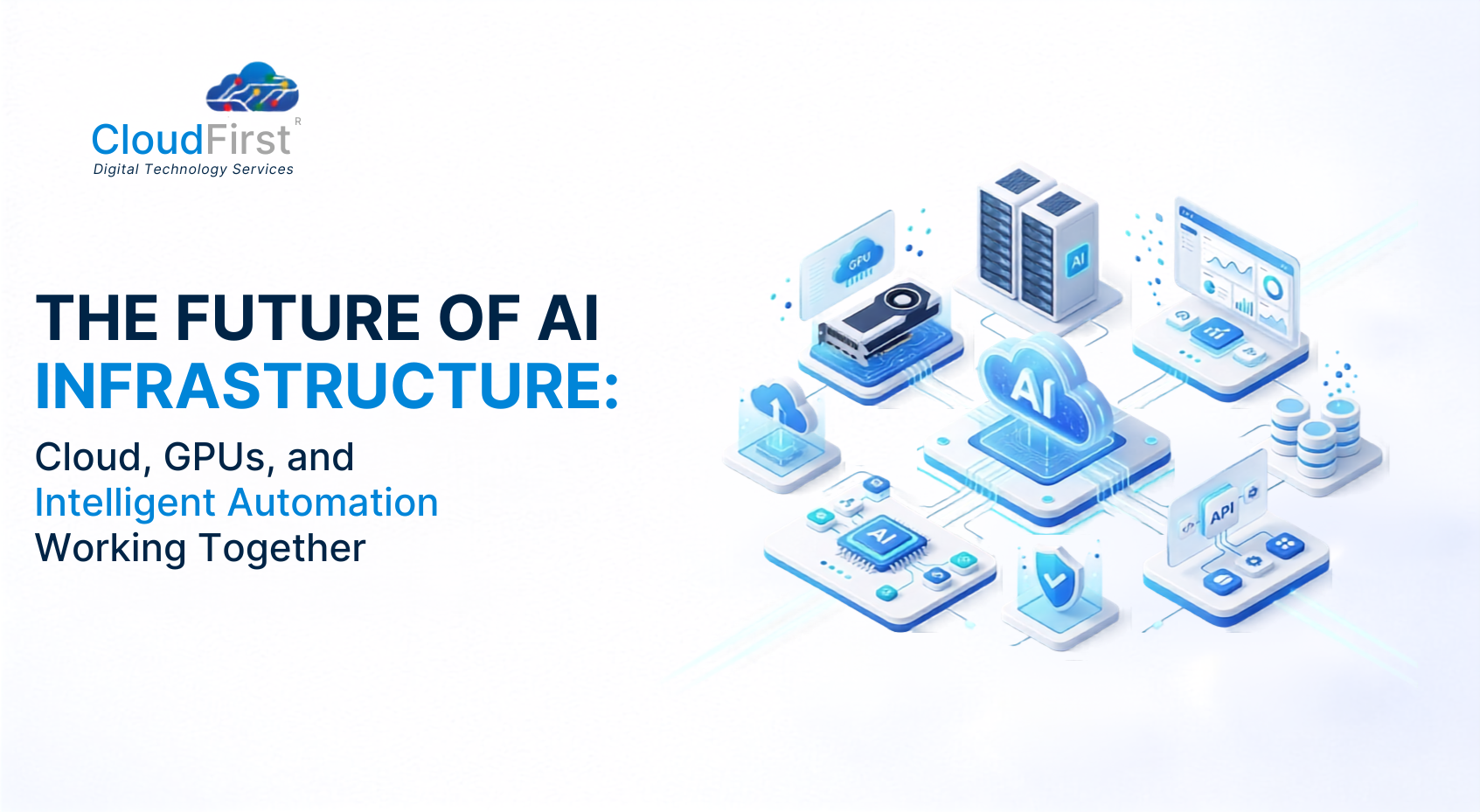
Artificial intelligence has moved from experimentation to execution. Enterprises across banking, financial services, insurance, and beyond are no longer asking if they should adopt AI, but how fast they can scale it responsibly. Behind every successful AI initiative, though, sits something less glamorous but far more decisive: infrastructure. The future of AI will not be shaped by algorithms alone — it will be shaped by how well cloud platforms, GPU compute, and intelligent automation work together as one integrated system.
Cloud as the Foundation, Not Just the Host
For years, cloud computing was viewed primarily as a place to store data and run applications. That role has expanded dramatically. Modern cloud platforms are now the control layer for AI — orchestrating data pipelines, managing model training environments, and enforcing governance across hybrid and multi-cloud setups.
For BFSI organizations in particular, this shift matters. Regulatory frameworks from RBI, SEBI, and IRDAI demand strict data residency, auditability, and security controls. A well-architected cloud foundation allows financial institutions to run AI workloads at scale while staying compliant — something that becomes nearly impossible with fragmented, on-premise-only systems.
Key cloud capabilities driving this shift:
- Elastic compute provisioning for unpredictable AI workloads
- Native integration with data lakes and warehouses
- Built-in compliance and encryption tooling
- Sovereign cloud options for regulated industries
GPUs: The Engine Room of Modern AI
If cloud is the foundation, GPUs are the engine. Training and running large language models, computer vision systems, and generative AI applications require massive parallel processing power that traditional CPUs simply cannot deliver efficiently.
What's changing now is access. GPU capacity — once locked behind expensive on-premise clusters — is increasingly available on-demand through cloud marketplaces and specialized GPU-as-a-service providers. This democratizes high-performance computing, letting mid-sized enterprises compete with tech giants on AI capability without massive upfront capital expenditure.
We're also seeing a rise in hybrid GPU strategies: sensitive workloads (like fraud detection models trained on customer data) run on dedicated, on-premise or sovereign GPU clusters, while less sensitive experimentation happens on public cloud GPU instances. This balances performance, cost, and compliance.
Why GPU strategy matters for enterprises:
- Faster model training translates directly to faster time-to-market
- Right-sizing GPU usage controls cloud spend, which can spiral quickly
- Dedicated GPU infrastructure supports low-latency, real-time inference — critical for use cases like real-time transaction monitoring
Intelligent Automation: The Connective Tissue
Cloud and GPUs provide the raw capability, but intelligent automation is what makes AI infrastructure usable at scale. Automation tools now manage everything from provisioning GPU clusters on demand, to auto-scaling based on workload, to routing AI inference requests intelligently across available compute resources.
This is where AIOps (AI for IT operations) and MLOps (machine learning operations) converge. Instead of manually managing infrastructure, teams increasingly rely on automated systems that:
- Detect anomalies in infrastructure performance before they cause downtime
- Automatically scale GPU and compute resources based on real-time demand
- Continuously monitor model drift and trigger retraining pipelines
- Optimize cloud costs by shutting down idle resources
For enterprises running dozens of AI models simultaneously, this automation isn't a nice-to-have — it's the only way to manage complexity without ballooning operational headcount.
Why These Three Must Work Together
The real breakthrough isn't any single component — it's the convergence. Consider a bank building a real-time fraud detection system:
- Cloud infrastructure provides the scalable, compliant environment to store and process transaction data
- GPU compute powers the machine learning models analyzing thousands of transactions per second
- Intelligent automation ensures the system scales during peak transaction periods (like festival shopping seasons) and flags anomalies to engineering teams instantly
Remove any one layer, and the system either becomes too slow, too expensive, or too fragile to trust with real financial decisions.
What This Means for Enterprises Today
Organizations preparing for this future should focus on three priorities:
Build cloud-native from day one. Legacy, on-premise-first architectures struggle to integrate GPU acceleration and automation tooling efficiently. Cloud-native design makes future AI adoption significantly smoother.
Treat GPU strategy as a business decision, not just a technical one. The choice between on-demand cloud GPUs, reserved instances, or dedicated clusters has direct implications for cost, compliance, and competitive speed.
Invest in automation early. Manual infrastructure management doesn't scale with AI ambitions. Organizations that automate provisioning, monitoring, and optimization early will scale AI initiatives far faster than competitors relying on manual processes.
Looking Ahead
The next few years will likely bring even tighter integration between these three pillars. Expect to see cloud providers embedding GPU orchestration directly into their core platforms, automation tools becoming more predictive rather than reactive, and industry-specific AI infrastructure (especially for regulated sectors like BFSI) becoming a standard offering rather than a custom build.
For enterprises, the takeaway is clear: AI success in the coming years will depend less on which model you choose, and more on whether your underlying infrastructure — cloud, GPU, and automation working in concert — can actually support it at scale.
Organizations that get this foundation right today will be the ones capable of deploying AI confidently, securely, and at speed tomorrow.
Conclusion
Cloud, GPUs, and intelligent automation are no longer separate concerns — they are converging into one unified infrastructure layer that determines how fast and how safely enterprises can scale AI. Getting this foundation right is a strategic advantage, not just a technical upgrade. This is where CloudFirst Technologies comes in. As an AWS Advanced Consulting Partner with deep expertise in cloud migration, managed services, DevOps, and GenAI — and a strong focus on the BFSI sector — CloudFirst helps enterprises design and manage the right combination of cloud, compute, and automation their AI ambitions require, without compromising on compliance or performance. Whether you're starting your AI infrastructure journey or optimizing an existing setup, partnering with a team that understands both the technology and the regulatory landscape can make all the difference.