



Introduction
It's 11 PM on a Friday. A customer orders the last blue jacket in your store's inventory—but your system doesn't know it was sold in-person two hours earlier.
By morning, you have an angry customer, a refund to process, and a reputation bruise that could have been entirely avoided.
This is the reality for thousands of retailers still running on legacy, siloed systems.
Cloud-based retail management was built precisely to eliminate this problem—and dozens more like it.
In this guide, we'll walk through how cloud technology transforms inventory control, customer relationships, and long-term growth strategy for retail businesses of every size.
Table of Contents
- Why Retail Is Moving to the Cloud
- Real-Time Inventory Management
- Knowing Your Customer Better
- Scaling Without the Growing Pains
- Choosing the Right Platform
- Getting Started: A Practical Roadmap
Why Retail Is Moving to the Cloud — Fast
The retail industry is undergoing its most dramatic technological shift in decades.
Consumers now expect seamless omnichannel experiences—browse online, buy in-store, return anywhere—and the infrastructure powering those experiences needs to be equally seamless behind the scenes.
Legacy on-premise systems simply weren't built for this world.
Cloud retail platforms solve this by giving every part of your business access to the same data, in real time. A sale in one store updates the website. A return processed at the counter reflects in reports instantly. Your warehouse team, marketing manager, and store staff are all working from the same picture.
Core Benefits of Cloud Retail Platforms
Real-Time Sync
Every sale, return, and reorder updates instantly across all channels and locations. There is no dependence on overnight batch processing that leaves data hours behind reality.
Accessible Anywhere
Manage operations from any device, whether you're on the store floor, traveling, or working remotely. Your entire business is always within reach.
Elastic Scalability
Handle seasonal demand spikes or new store openings without purchasing additional hardware or worrying about server capacity. Cloud infrastructure scales automatically with demand.
Built-In Security
Encryption, automated backups, and compliance frameworks come standard. Retailers gain enterprise-grade protection without maintaining a dedicated IT department.
Cloud isn't a trend in retail anymore—it's the baseline expectation for any business that wants to compete in the next five years.
Real-Time Inventory Management: The End of Stockout Surprises
Inventory is the heartbeat of retail.
Too much stock ties up capital and fills warehouses with products that aren't moving. Too little inventory results in lost sales, disappointed customers, and urgent reorders.
Cloud-based inventory management gives retailers the visibility and control required to maintain the right balance consistently.
What Changes When Inventory Moves to the Cloud
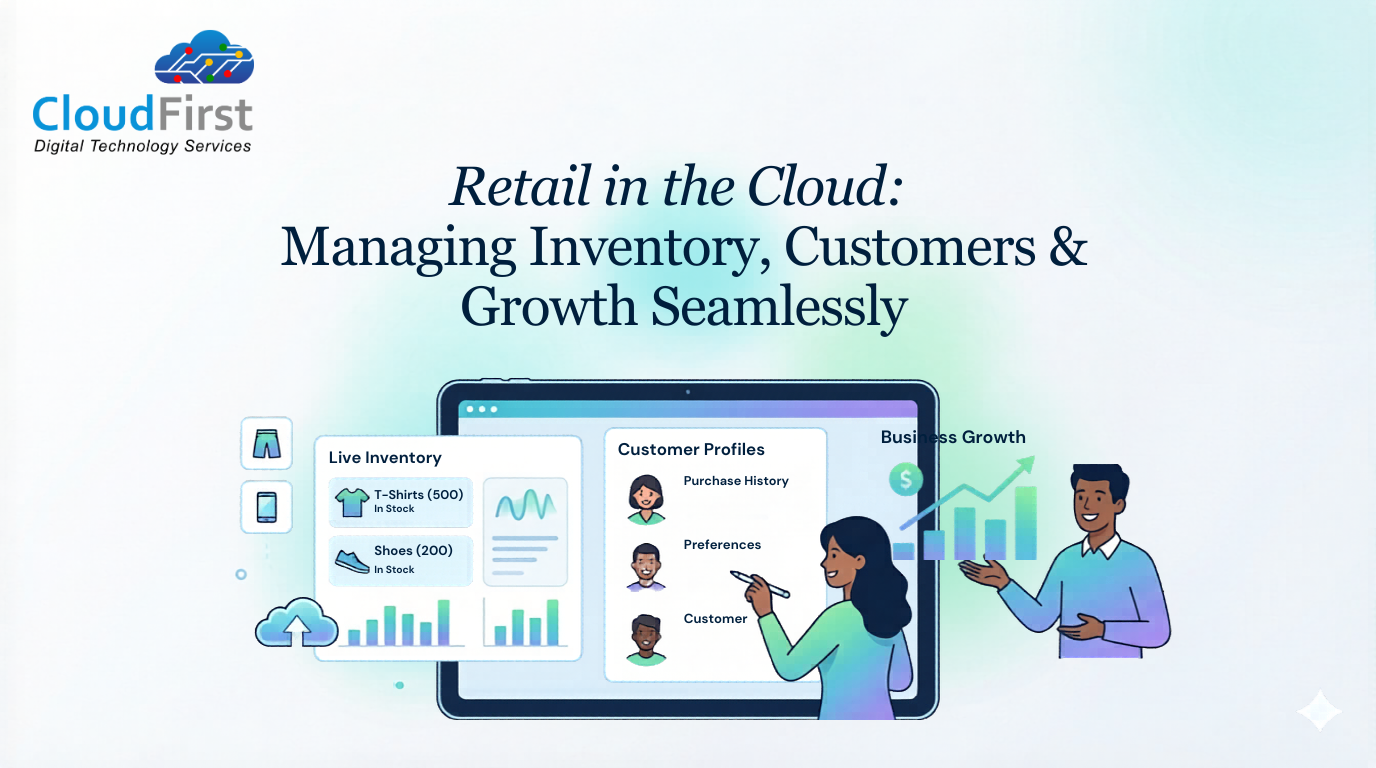
The most immediate shift is that inventory becomes a live reflection of reality.
A sale in your Mumbai store reduces available stock on your website at the same moment. Your warehouse team sees it. Your buying team sees it. Everyone works from the same current information.
This enables capabilities that disconnected systems simply cannot provide.
Key Inventory Management Capabilities
- Automatic low-stock alerts before inventory runs out
- Full visibility across every location through a single dashboard
- Barcode and RFID integration for automated stock updates
- Automated purchase orders when stock reaches reorder thresholds
- AI-powered demand forecasting using historical and seasonal trends
- Identification of dead stock before it becomes a write-off
Smarter Fulfillment Across Channels
For omnichannel retailers, cloud inventory management unlocks intelligent fulfillment strategies.
Retailers can:
- Reserve inventory buffers for in-store customers
- Route online orders to the nearest stocked location
- Enable ship-from-store fulfillment when warehouse inventory runs low
What once required expensive custom development can now be achieved through simple configuration.
The SEO Advantage Most Retailers Overlook
Inventory accuracy has a direct impact on search performance.
When products appear out of stock on your website or shopping platforms, search engines often treat those listings as lower quality and reduce their visibility.
Better inventory forecasting and cross-location fulfillment help keep products available, protecting organic rankings and maximizing paid advertising performance.
Knowing Your Customer Better Than They Know Themselves
Modern retail is no longer just about selling products.
It's about building relationships that drive repeat business and long-term loyalty.
Cloud-based customer management tools make sophisticated customer intelligence accessible to businesses of all sizes.
The Unified Customer Profile
Every customer interaction generates valuable data.
Customers browse products, make purchases, contact support, engage with promotions, and visit stores. In traditional systems, this information is often scattered across separate databases.
Cloud retail platforms bring everything together into a single customer profile.
Retailers can see:
- Purchase history
- Preferred shopping channels
- Product preferences
- Spending patterns
- Responses to previous campaigns
This unified view becomes the foundation for personalized experiences and proactive customer service.
Personalization That Delivers Results
With a complete customer view, retailers can communicate more effectively.
Examples of Personalized Engagement
- Promotions based on previous purchases and browsing activity
- Loyalty programs tailored to customer behavior
- Re-engagement campaigns for inactive customers
- Product recommendations driven by actual buying patterns
- In-store assistance informed by customer purchase history
Segmentation and Lifecycle Strategy
Not all customers contribute equally to business growth.
Cloud CRM platforms support segmentation models such as RFM (Recency, Frequency, Monetary Value), helping retailers identify:
- High-value customers
- Customers at risk of churn
- One-time buyers with strong repeat-purchase potential
Compared to generic marketing campaigns, well-segmented lifecycle marketing often produces significantly higher engagement and repeat purchase rates.
Scaling Without the Growing Pains
Growth is every retailer's goal.
However, growth without the right infrastructure often leads to operational complexity and inefficiency.
Cloud retail architecture fundamentally changes the cost and effort required to expand.
Opening a New Location Becomes Simpler
Traditional retail systems require extensive setup when opening a new store.
Businesses must purchase hardware, install software, configure databases, migrate data, and train employees.
Cloud platforms remove most of this complexity.
New locations inherit:
- Product catalogs
- Pricing structures
- Loyalty programs
- Reporting frameworks
- Operational workflows
As a result, new stores become fully operational much faster.
Consistency Across Every Channel
As retailers grow, maintaining consistency becomes increasingly important.
Cloud platforms ensure that promotions, pricing updates, loyalty programs, and operational rules remain synchronized across every store and sales channel.
Whether a customer shops in Delhi, Dubai, online, or in-store, the experience remains consistent.
Making Smarter Expansion Decisions
Cloud analytics provide retailers with real purchasing and behavioral data that supports expansion planning.
Before entering a new market, businesses can analyze:
- Product category performance
- Customer demographics
- Average order values
- Regional purchasing trends
Expansion decisions become data-driven rather than based on assumptions.
Growing Across Borders
For retailers with international ambitions, cloud platforms simplify:
- Multi-currency operations
- Regional tax requirements
- Local compliance regulations
- Consolidated reporting
Geographic expansion becomes a business decision rather than a technical challenge.
Choosing the Right Cloud Retail Platform
The cloud retail software market is crowded, and not every platform is suitable for every business.
Selecting the right platform from the start can save significant time and effort later.
Integration Ecosystem
A retail platform should integrate seamlessly with existing business systems.
Consider compatibility with:
- Ecommerce platforms
- Accounting software
- Logistics providers
- Marketing tools
- Customer service systems
Understand what integrations are native and where custom development may be required.
Reliability and Uptime
Retail operations cannot afford downtime.
Look for platforms that offer:
- 99.9% or higher uptime SLAs
- Transparent uptime history
- Clear incident management procedures
- Fast communication during outages
Analytics and Reporting
The best platforms do more than store data.
Look for:
- Flexible reporting tools
- Custom dashboards
- Demand forecasting capabilities
- Customer churn indicators
- Inventory optimization insights
Support Quality
Support quality matters when problems occur during critical sales periods.
Evaluate:
- Availability of 24/7 support
- Guaranteed response times
- Retail-specific expertise
- Escalation processes
Pricing Transparency
Understand how pricing changes as your business grows.
Evaluate costs based on:
- Additional locations
- More users
- Increased transaction volume
- Future growth projections
Questions to Ask Every Vendor
- How do you handle peak traffic during major sales events?
- What does migration from our current system involve?
- Are updates deployed with or without downtime?
- How is customer data secured and kept compliant?
Getting Started: A Practical Roadmap
Cloud migration doesn't need to happen all at once.
The most successful retailers approach migration in structured phases.
Days 1–30: Audit and Select
Begin by documenting your current systems, identifying where data resides, and understanding your biggest operational challenges.
Use these insights to evaluate platforms based on your actual business needs rather than feature lists.
During this phase:
- Run product demonstrations
- Test platforms with real data
- Speak with reference customers
- Validate critical requirements
Days 31–60: Migrate and Validate
Start migrating:
- Core inventory data
- Primary sales channels
- Key integrations
Train a core group of users and operate both systems in parallel for a defined period.
This validation phase helps identify discrepancies before they impact customers.
Days 61–90: Launch and Optimize
Once fully live, focus on adoption and continuous improvement.
Establish baseline metrics such as:
- Inventory accuracy
- Stockout frequency
- Fulfillment speed
- Customer satisfaction
- Sales performance
Use these metrics to guide optimization efforts.
What to Expect
Retailers that complete a structured cloud migration often experience noticeable improvements within the first quarter.
Common outcomes include:
- Fewer stockouts
- Faster fulfillment
- Reduced manual effort
- Improved operational visibility
Long-term benefits continue to compound as data quality improves and decision-making becomes more informed.
The objective is not a perfect migration.
The objective is a better business.
Final Thoughts
Retail in the cloud isn't about technology for its own sake.
It's about removing the friction—the stockouts, disconnected systems, manual processes, and operational guesswork—that slows growth and frustrates customers.
The retailers thriving today are the ones that have unified their inventory, customer data, and operational infrastructure into a single intelligent platform.
Cloud technology makes that possible for businesses of every size.
The question isn't whether to make the move.
It's how soon—and how well.
Connect with our certified cloud architects and start your transformation journey today.
Visit us at: https://cloudfirst.tech/