





Cloud adoption has evolved dramatically over the last decade. While many organizations initially viewed moving everything to the public cloud as the ultimate goal, today's enterprise landscape tells a different story. Businesses are realizing that no single cloud environment can meet every operational, security, compliance, and performance requirement.
This shift has made hybrid cloud one of the fastest-growing IT strategies in 2026.
Rather than choosing between on-premises infrastructure and the public cloud, organizations are embracing a hybrid approach that combines the strengths of both. The result is greater flexibility, improved security, better performance, and optimized costs—all while enabling innovation at scale.
Whether supporting mission-critical applications, handling sensitive customer data, or preparing for AI-driven workloads, hybrid cloud has become the preferred choice for businesses looking to modernize without sacrificing control.
What Is a Hybrid Cloud?
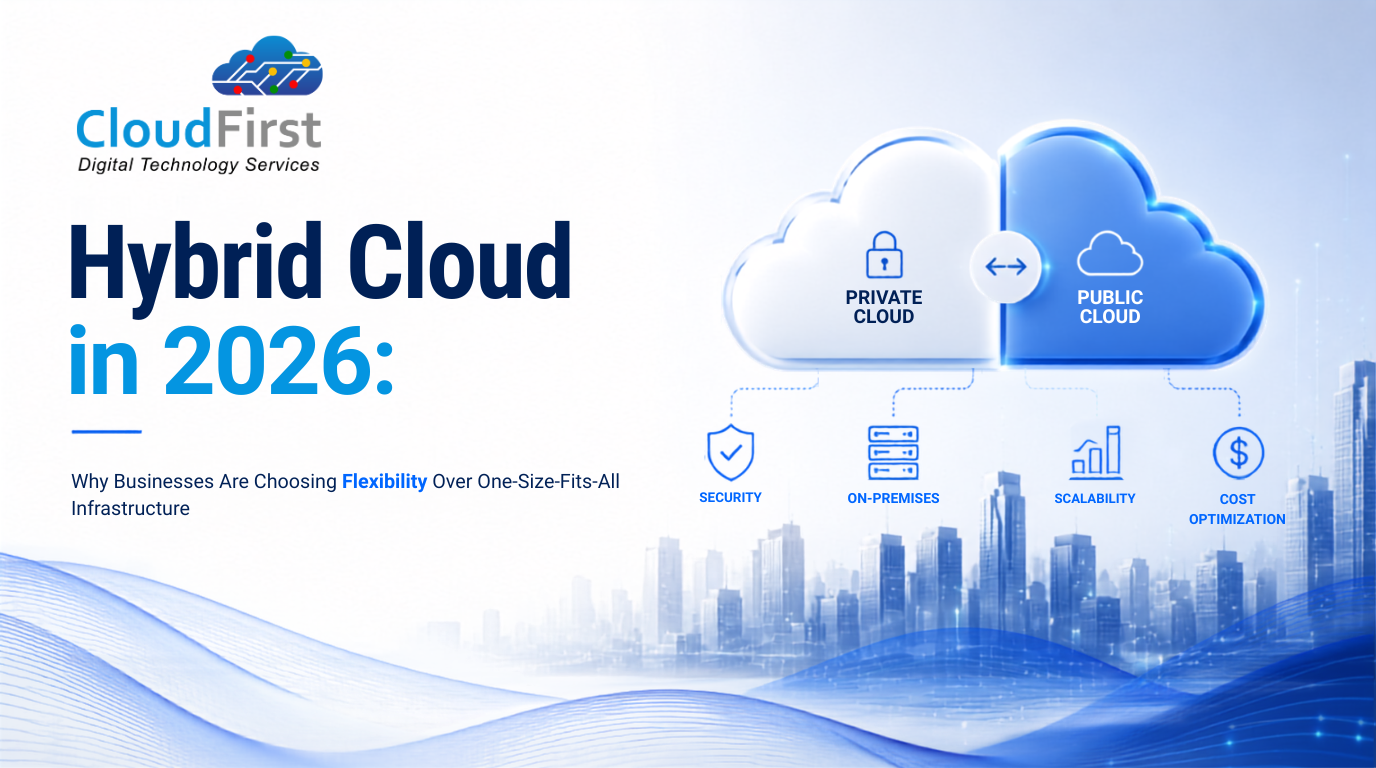
A hybrid cloud is an IT environment that combines private infrastructure—such as on-premises data centers or private clouds—with one or more public cloud platforms. These environments are securely connected, allowing applications and data to move seamlessly based on business needs.
Unlike traditional infrastructure, a hybrid cloud gives businesses the freedom to run each workload in the environment best suited for it.
For example:
- Customer-facing applications can leverage the scalability of the public cloud.
- Financial or healthcare data can remain in a private environment to meet compliance requirements.
- Legacy applications can continue running on existing systems while newer applications are deployed in the cloud.
This flexibility helps organizations modernize at their own pace rather than undergoing disruptive, large-scale migrations.
Why Hybrid Cloud Is Gaining Momentum
The growing adoption of artificial intelligence, stricter data regulations, and the demand for uninterrupted digital services have made hybrid cloud a strategic priority.
Businesses are increasingly choosing hybrid cloud because it offers:
- Greater operational flexibility
- Improved business continuity
- Better workload performance
- Enhanced data security
- Easier compliance management
- Reduced infrastructure costs
- Faster innovation
Instead of forcing every application into a single environment, organizations can optimize where each workload runs.
Key Benefits of a Hybrid Cloud Strategy
1. Flexibility Without Compromise
Every application has unique requirements.
Some workloads require high-performance computing, while others prioritize cost efficiency or regulatory compliance. Hybrid cloud enables organizations to match infrastructure with business needs rather than adapting applications to infrastructure limitations.
This flexibility also simplifies future technology adoption as business requirements evolve.
2. Stronger Security and Compliance
Many industries handle sensitive information that cannot always be stored in public cloud environments.
Hybrid cloud allows businesses to retain full control over critical data while leveraging public cloud services for less-sensitive workloads.
Combined with encryption, identity management, and continuous monitoring, hybrid cloud provides a strong foundation for modern cybersecurity.
3. Improved Business Continuity
Unexpected disruptions can occur at any time.
By distributing applications across multiple environments, businesses reduce the risk of downtime caused by hardware failures, cyberattacks, or regional outages.
A resilient hybrid cloud strategy supports disaster recovery planning and ensures critical business operations continue even during unexpected events.
4. Cost Optimization
Not every workload requires expensive high-performance infrastructure.
Hybrid cloud allows organizations to:
- Scale resources during peak demand
- Reduce capital expenditure
- Eliminate underutilized infrastructure
- Optimize operational costs
- Pay only for resources when needed
This balance helps businesses maximize the return on their cloud investments.
5. Faster Digital Transformation
Modern businesses need to launch applications, deploy updates, and adopt new technologies quickly.
Hybrid cloud accelerates innovation by enabling development teams to build cloud-native applications while maintaining compatibility with existing enterprise systems.
Organizations can modernize incrementally instead of replacing everything at once.
Common Use Cases for Hybrid Cloud
Hybrid cloud is suitable for organizations across industries.
Some of the most common applications include:
AI and Machine Learning
Organizations can process large AI workloads in the public cloud while securely storing proprietary datasets in private environments.
Disaster Recovery
Critical systems can be replicated across environments to ensure rapid recovery if one location experiences downtime.
Data Backup
Hybrid architectures provide multiple backup locations, improving resilience and reducing recovery times.
Seasonal Workloads
Retailers, financial institutions, and online platforms can automatically scale cloud resources during peak demand while minimizing costs during quieter periods.
Legacy Application Modernization
Businesses can gradually modernize older systems without interrupting daily operations.
Challenges Businesses Should Consider
Although hybrid cloud offers numerous advantages, successful implementation requires careful planning.
Organizations should focus on:
- Network connectivity
- Security governance
- Identity management
- Data integration
- Cost monitoring
- Performance optimization
- Compliance management
Without proper planning, hybrid environments can become complex to manage.
Partnering with experienced cloud specialists helps organizations simplify deployment while maximizing long-term value.
Preparing for the Future
The next generation of enterprise technologies—including AI agents, predictive analytics, edge computing, and IoT—will depend on flexible cloud environments capable of supporting diverse workloads.
Hybrid cloud provides the scalability and adaptability required for these emerging technologies.
As businesses continue to embrace digital transformation, hybrid cloud will become less of an option and more of a business necessity.
Organizations that establish a well-designed hybrid cloud strategy today will be better positioned to respond to changing customer expectations, evolving regulations, and future technological innovations.
Final Thoughts
The future of enterprise IT isn't about choosing between on-premises infrastructure and the cloud. It's about combining the strengths of both.
Hybrid cloud empowers organizations to improve agility, strengthen security, optimize costs, and ensure business continuity while maintaining the flexibility needed to support long-term growth.
Businesses that invest in hybrid cloud today are building a technology foundation capable of adapting to tomorrow's challenges.
How CloudFirst Helps Businesses Build Hybrid Cloud Solutions
Successfully implementing a hybrid cloud strategy requires the right expertise, planning, and ongoing management. CloudFirst helps organizations design, migrate, secure, and optimize hybrid cloud environments that align with business objectives. From cloud migration and infrastructure modernization to managed cloud services, disaster recovery, cybersecurity, backup solutions, and 24×7 cloud support, CloudFirst delivers end-to-end services that enable businesses to achieve greater flexibility, resilience, and operational efficiency while preparing for future innovation.