



For years, enterprise cloud strategy followed a familiar direction: move workloads to the public cloud, gain scalability, reduce infrastructure management, and accelerate innovation.
But the AI era is challenging that assumption.
As organizations move from AI experimentation to production-scale deployments, the economics and infrastructure requirements of AI workloads are becoming increasingly difficult to ignore. Large-scale inference, GPU utilization, data movement, security requirements, and predictable performance are forcing technology leaders to rethink where AI workloads should actually run.
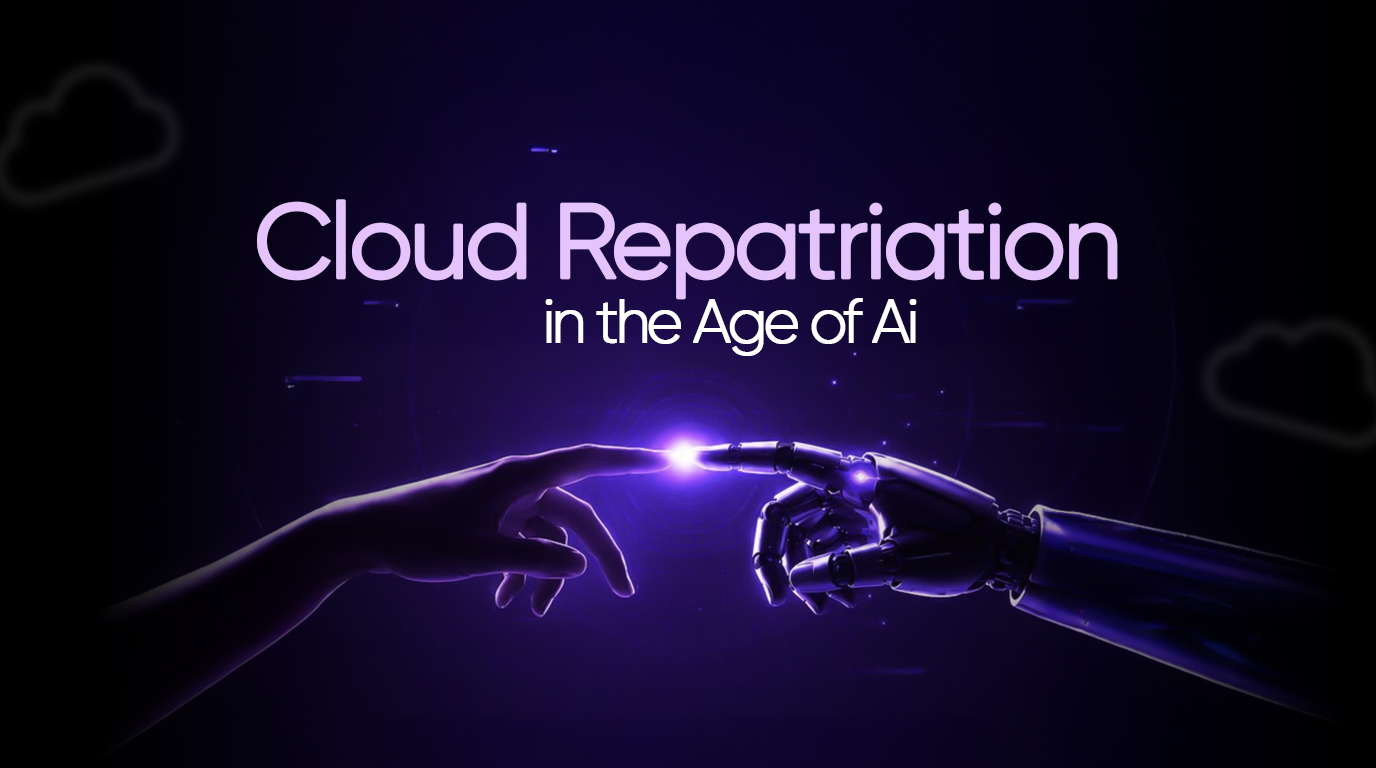
This has brought Cloud Repatriation back into the enterprise conversation.
But this time, the question is not whether organizations should leave the cloud. The more important question is:
Which AI workloads should remain in the public cloud, and which ones could deliver better value on private or hybrid infrastructure?
Why AI Is Changing the Cloud Repatriation Debate
The traditional advantages of public cloud remain compelling. Organizations can access computing resources on demand, scale workloads quickly, and avoid large upfront infrastructure investments.
AI, however, introduces a different cost and performance profile.
AI workloads can continuously consume significant amounts of compute, memory, networking, storage, and energy. Inference becomes especially important when an AI application is used at scale because the workload is no longer occasional—it can run continuously across thousands or millions of requests.
Industry research in 2026 shows this shift becoming more visible. One enterprise survey found that 56% of organizations are running or planning production AI inference on private cloud, while public-cloud use for those workloads fell from 56% to 41% year over year.
This does not mean public cloud is becoming irrelevant.
It means AI is forcing enterprises to become more selective about where workloads run.
The Real Cost of Running AI in the Cloud
When organizations evaluate cloud costs, they often focus on compute or model usage. AI requires a broader view.
A production AI environment may involve:
- GPU or accelerator consumption
- Model inference
- Storage
- Data transfer
- Networking
- Observability
- Security services
- Model hosting
- Data processing
The challenge becomes more significant when workloads are predictable and run continuously.
For example, an organization operating a high-volume AI inference platform may not need highly elastic infrastructure every minute of the day. If the workload remains consistently high, owning or dedicating infrastructure could potentially provide more predictable economics than continuously paying consumption-based cloud rates.
This is one reason AI Infrastructure economics are becoming a strategic consideration for CIOs and CTOs.
Recent industry analysis also points to infrastructure costs—including compute, memory, networking, electricity, and cooling—as increasingly important components of enterprise AI economics.
Data Sovereignty Is Becoming More Important
Cost is only one part of the discussion.
AI systems often process highly sensitive enterprise information, including customer records, financial data, intellectual property, employee information, and proprietary business knowledge.
For organizations operating in highly regulated sectors, maintaining control over where data is stored and processed can become a major architectural requirement.
This is particularly relevant for businesses dealing with:
- Financial data
- Healthcare information
- Government workloads
- Customer identity data
- Proprietary enterprise data
- Regulated workloads
Private infrastructure can provide greater control over the underlying environment, data location, access policies, and security architecture.
This does not automatically make private cloud more secure than public cloud. Rather, it can give organizations greater control over how security and governance requirements are implemented.
When Private Cloud Makes Sense for AI
Not every AI workload should be repatriated.
Private cloud becomes more compelling when workloads have characteristics such as:
Predictable AI Workloads
If an AI application runs continuously with relatively stable demand, dedicated infrastructure can become easier to optimize.
High Data Sensitivity
Organizations processing highly confidential or regulated information may prefer environments where they have greater control over data and infrastructure.
Performance Requirements
Certain AI applications require predictable latency and dedicated compute resources. Controlling the infrastructure stack can help organizations optimize performance for these workloads.
Long-Term High Utilization
Cloud elasticity is extremely valuable when workloads fluctuate.
But when expensive AI infrastructure remains heavily utilized for long periods, the economics can look very different.
Infrastructure Control
Organizations building strategic AI capabilities may want greater control over hardware, networking, model deployment, and the underlying infrastructure lifecycle.
When Public Cloud Is Still the Better Choice
Cloud repatriation should not become the new version of “everything should move on-premises.”
Public cloud remains highly valuable for many AI workloads.
It can be particularly effective for:
- AI experimentation
- Short-term training workloads
- Variable workloads
- Rapid product development
- Global AI applications
- Bursty inference
- Access to managed AI services
For organizations still validating an AI use case, investing heavily in dedicated infrastructure may introduce unnecessary complexity.
Public cloud allows teams to experiment quickly and scale when demand exists without committing to long-term infrastructure investments.
The Hybrid Cloud Model May Be the Real Answer
For many enterprises, the future will not be public cloud or private cloud.
It will be hybrid cloud.
Organizations can place workloads according to their technical and business characteristics.
For example:
Public Cloud: AI experimentation, temporary workloads, burst capacity, and globally distributed applications.
Private Cloud: Sensitive data, predictable inference workloads, regulated applications, and high-utilization AI systems.
Hybrid Architecture: Workloads that need to move between environments depending on performance, cost, data sensitivity, or demand.
This approach allows organizations to use the public cloud where flexibility creates value while keeping strategic workloads under greater infrastructure control.
AI Is Also Changing FinOps
Traditional Cloud FinOps focused heavily on optimizing virtual machines, storage, databases, and network consumption.
AI introduces additional variables.
Organizations now need visibility into:
- GPU utilization
- Inference cost
- Token consumption
- Model selection
- Data movement
- AI workload utilization
- Cost per AI request
- Cost per business outcome
This means FinOps teams increasingly need to work alongside AI and infrastructure teams.
The objective is no longer simply to reduce the cloud bill.
It is to understand where AI creates business value and which infrastructure model delivers that value most efficiently.
Cloud Repatriation Does Not Mean Going Back to the Old Data Center
One important distinction is often missed in the repatriation debate.
Moving a workload away from a hyperscale public cloud does not necessarily mean rebuilding a traditional data center.
Enterprises can use:
- Modern private cloud
- Colocation facilities
- Managed private infrastructure
- Dedicated AI infrastructure
- Hybrid cloud platforms
This allows organizations to retain many cloud-like operating principles—automation, orchestration, self-service, and centralized management—while gaining greater control over the underlying infrastructure.
That makes modern Private Cloud Infrastructure fundamentally different from the traditional on-premises model many organizations moved away from years ago.
The Question Enterprises Should Ask
Instead of asking:
“Should we move our AI workloads back from the cloud?”
Technology leaders should ask:
“Where does each AI workload achieve the best combination of cost, performance, security, scalability, and control?”
That shift in thinking is important.
A customer-facing AI application with unpredictable demand may benefit from public cloud elasticity.
A continuously running inference platform processing sensitive enterprise data may benefit from private infrastructure.
An organization experimenting with new models may prefer public cloud, while its mature production workloads could eventually move toward a hybrid architecture.
The right answer may therefore be different for every workload within the same organization.
What the Future of AI Infrastructure Could Look Like
The next generation of enterprise AI infrastructure is likely to be more distributed and workload-specific.
Rather than placing every workload in a single environment, organizations will increasingly decide where AI should run based on business requirements.
Recent enterprise research already indicates this direction: security and compliance, cost predictability, and performance are among the leading drivers behind workload repatriation, while AI training, LLMs, and inference have emerged as a distinct category being considered for movement to private cloud.
The result could be a more balanced cloud strategy—one where public cloud, private cloud, and dedicated AI infrastructure work together rather than compete.
Building the Right AI Infrastructure Strategy
Cloud Repatriation should not be treated as a blanket migration strategy.
It should be approached as a workload optimization exercise.
Organizations need to evaluate their AI workloads based on utilization, data sensitivity, latency requirements, scalability, infrastructure costs, compliance obligations, and long-term business value.
At CloudFirst Technology, we help organizations evaluate and modernize their Cloud Infrastructure strategies for the AI era—from Cloud Repatriation and Hybrid Cloud Architecture to AI Infrastructure, Cloud FinOps, workload optimization, and secure cloud modernization. Our focus is to help enterprises determine where each workload should run to achieve the right balance of performance, cost, security, and control.
If your organization is reconsidering its cloud strategy as AI workloads move into production, we would be glad to help you assess the environment and architect the right path forward.