




Artificial Intelligence is rapidly transforming how businesses operate, compete, and innovate. Across industries such as banking, healthcare, retail, manufacturing, and technology, organizations are investing in AI to improve operational efficiency, enhance customer experiences, and create new revenue opportunities.
As enterprises move beyond experimentation and begin integrating AI into core business functions, one question continues to emerge:
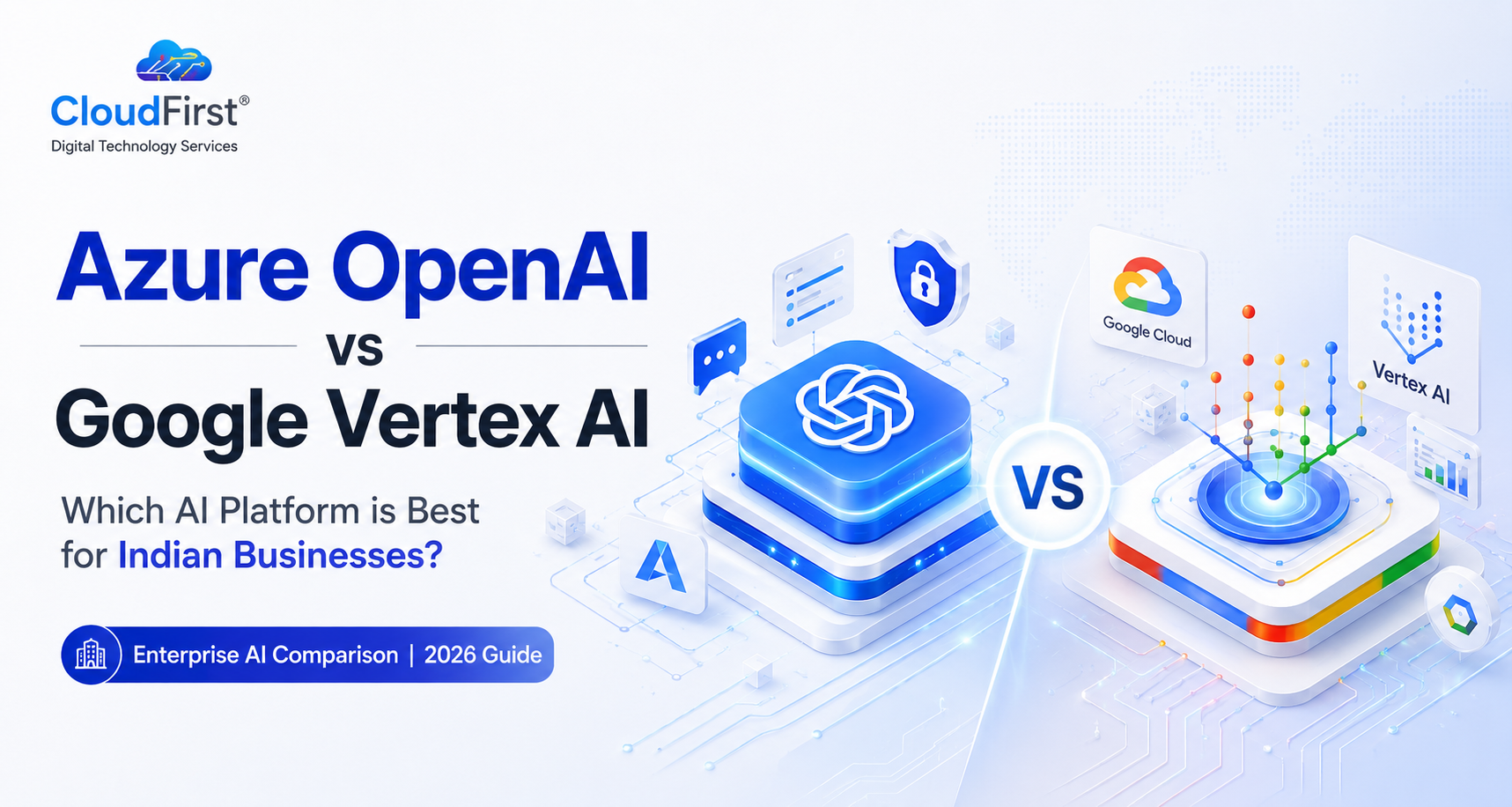
Should organizations choose Azure OpenAI or Google Vertex AI?
Both platforms provide advanced AI capabilities, enterprise-grade security, and scalable cloud infrastructure. However, each platform is built with different strengths, ecosystems, and strategic priorities. Understanding these differences is essential for organizations planning long-term AI adoption and digital transformation initiatives.
The Rise of Enterprise AI in India
India's AI landscape is evolving rapidly. Businesses are no longer viewing AI as an experimental technology but as a strategic capability that can drive productivity, innovation, and competitive advantage.
From AI-powered customer support and intelligent document processing to predictive analytics and enterprise assistants, organizations are looking for platforms that support innovation while maintaining governance and compliance.
This growing demand has positioned Azure OpenAI and Google Vertex AI among the leading AI platforms for enterprises today.
Understanding Azure OpenAI
Azure OpenAI combines Microsoft's cloud infrastructure with OpenAI's advanced language models to deliver enterprise-ready AI capabilities.
Built on Microsoft Azure, the platform enables organizations to develop intelligent applications, automate workflows, generate content, and deploy AI-powered assistants while maintaining enterprise-grade security standards.
For businesses already using Microsoft technologies such as Microsoft 365, Dynamics 365, Power Platform, and Azure services, Azure OpenAI provides a highly integrated environment for AI adoption.
Why Organizations Choose Azure OpenAI
Organizations commonly leverage Azure OpenAI for:
- Generative AI applications
- Enterprise chatbots
- AI copilots
- Content generation
- Knowledge management systems
- Customer service automation
- Business process optimization
One of its greatest advantages is the ability to integrate AI directly into existing Microsoft environments, reducing implementation complexity and accelerating time-to-value.
Understanding Google Vertex AI
Google Vertex AI is Google's unified AI and machine learning platform designed to help organizations build, deploy, and scale AI solutions efficiently.
Unlike platforms focused solely on generative AI, Google Vertex AI provides a broader ecosystem for machine learning, predictive analytics, multimodal AI, and data-driven decision-making.
Organizations already leveraging Google Cloud often benefit from seamless integration with BigQuery, advanced analytics frameworks, and data engineering pipelines.
Why Organizations Choose Google Vertex AI
Organizations frequently adopt Google Vertex AI for:
- Predictive analytics
- Machine learning operations
- Data science initiatives
- Multimodal AI applications
- Forecasting and recommendations
- Large-scale data processing
For businesses driven by data and analytics, Vertex AI offers extensive customization and flexibility.
Comparing Azure OpenAI and Google Vertex AI
AI Model Capabilities
Both Azure OpenAI and Google Vertex AI provide access to advanced AI models capable of supporting enterprise-scale use cases.
Azure OpenAI offers access to GPT models known for conversational intelligence, content generation, reasoning, and workflow automation.
Google Vertex AI provides access to Gemini models that support multimodal experiences across text, images, code, and other data formats.
The choice often depends on business objectives rather than model performance alone.
Enterprise Integration
Integration remains one of the most important factors in AI adoption.
Organizations invested in Microsoft technologies often find Azure OpenAI easier to deploy and integrate into existing workflows.
Businesses operating primarily within Google Cloud environments may experience similar advantages with Google Vertex AI.
The platform that aligns with an organization's current technology stack typically delivers faster implementation and greater operational efficiency.
Security and Governance
Security is a critical requirement for enterprise AI deployments.
Both Azure OpenAI and Google Vertex AI provide enterprise-grade security controls, compliance frameworks, identity management systems, and governance capabilities.
For industries such as banking, insurance, healthcare, and government, both platforms can support strict regulatory and compliance requirements while enabling innovation at scale.
Scalability and Business Readiness
Enterprise AI initiatives must be designed for growth.
Whether organizations are deploying AI assistants, automating customer interactions, or building intelligent analytics platforms, scalability remains essential.
Both Azure OpenAI and Google Vertex AI provide cloud-native infrastructure capable of supporting enterprise workloads across departments, regions, and business units.
This allows organizations to move from pilot projects to enterprise-wide AI deployments without significant limitations.
Which Platform Is Better for Indian Businesses?
There is no universal answer because every organization has unique business objectives and technology requirements.
Organizations focused on Generative AI Solutions, business productivity, AI assistants, and Microsoft ecosystem integration often find Azure OpenAI to be the preferred choice.
Businesses prioritizing machine learning, predictive analytics, and large-scale data processing may derive greater value from Google Vertex AI.
The most effective decision comes from evaluating existing infrastructure, operational requirements, governance needs, and long-term AI goals rather than comparing features alone.
The Future of Enterprise AI in India
The next phase of AI adoption in India will be defined by how effectively organizations combine AI capabilities with cloud infrastructure, governance frameworks, and business processes.
As AI becomes increasingly embedded within enterprise operations, businesses will require platforms capable of supporting innovation while maintaining security, compliance, and scalability.
Organizations that build a strong Enterprise AI Platform today will be better positioned to drive innovation, improve efficiency, and maintain a competitive advantage in the future.
Choosing the Right AI Platform for Long-Term Success
The decision between Azure OpenAI vs Google Vertex AI is not simply about selecting a technology platform—it is about building a scalable foundation for future innovation. As Indian businesses accelerate their AI adoption journey, the focus should be on choosing a platform that aligns with organizational goals, existing technology investments, security requirements, and long-term growth strategies.
Whether your organization is looking to deploy AI-powered assistants, automate business processes, enhance customer experiences, or unlock insights from enterprise data, the right AI platform can become a catalyst for sustainable transformation.
At CloudFirst, we help organizations evaluate, design, and implement enterprise AI solutions that align with real business outcomes. From Azure OpenAI implementation, Google Vertex AI adoption, and Generative AI Solutions to cloud modernization, AI Strategy Development, and Intelligent Automation frameworks, we help businesses build AI ecosystems that are secure, scalable, and future-ready.
If your organization is ready to move beyond AI experimentation and build a practical roadmap for enterprise AI adoption, our team would be glad to help you architect the journey.