




Enterprise AI, AI Infrastructure, Cloud Security, Cloud Cost Optimization, MLOps, Cloud Monitoring, Responsible AI
Artificial intelligence is no longer limited to experimentation. Organizations across industries are deploying AI-powered chatbots, predictive analytics, recommendation engines, and intelligent automation into everyday business operations. However, deploying AI is only the beginning. The real challenge lies in ensuring these systems remain reliable, secure, compliant, and cost-efficient over time.
This is where AI Observability is becoming one of the most important pillars of modern Enterprise AI strategies.
What Is AI Observability?
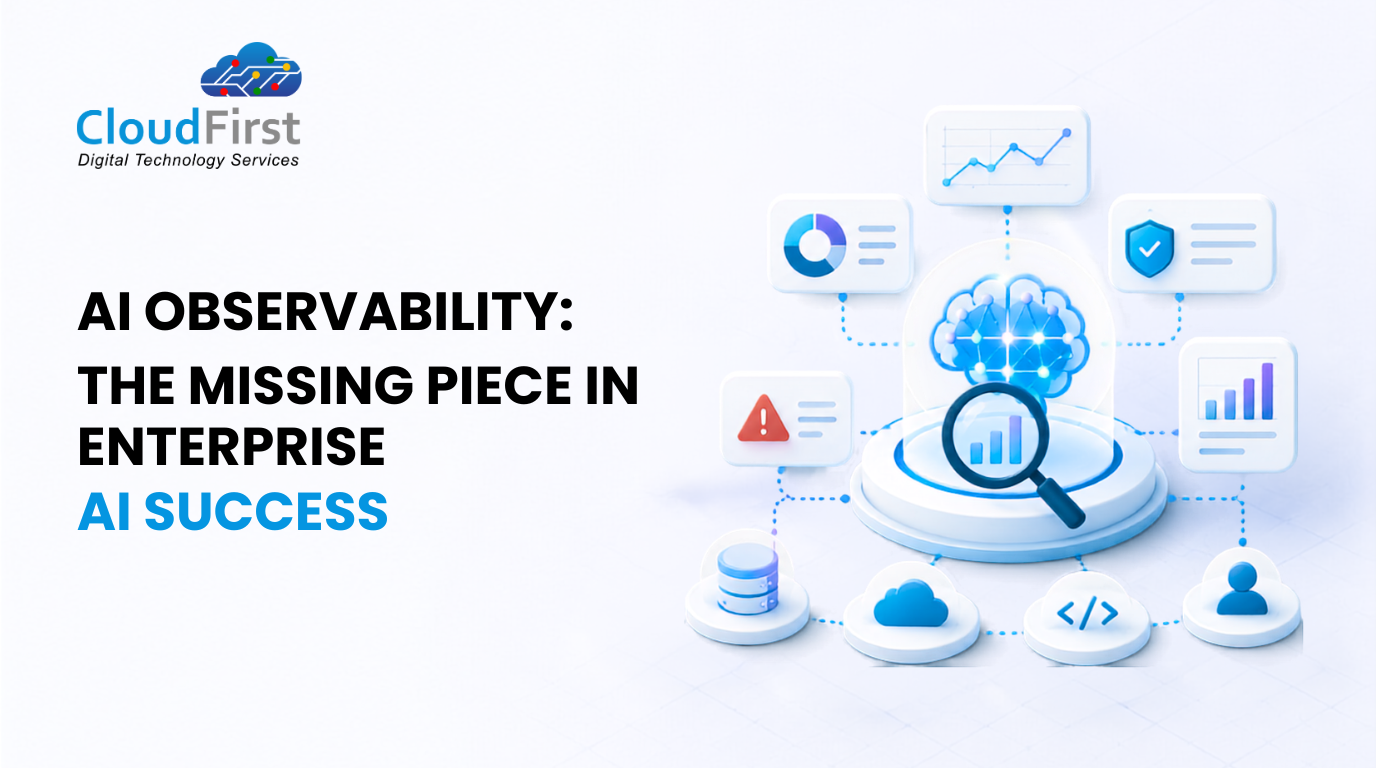
Unlike traditional application monitoring, AI Observability provides complete visibility into how AI models perform after deployment. It tracks everything from model accuracy and response quality to infrastructure utilization, latency, data drift, and operational costs.
As businesses continue investing in AI Infrastructure, simply monitoring servers and applications is no longer enough. Organizations need insights into the behavior of their AI models to ensure consistent business outcomes.
Why Traditional Monitoring Falls Short
Traditional monitoring tools focus on CPU usage, memory, network performance, and application uptime. While these metrics remain important, AI workloads introduce additional complexities such as:
- Model drift caused by changing data patterns
- Unexpected inference latency
- Increasing GPU utilization
- Prompt performance in Generative AI applications
- Escalating cloud costs due to inefficient AI workloads
Without proper visibility, businesses risk reduced model accuracy, higher operational expenses, and compliance challenges.
The Business Benefits of AI Observability
1. Improved AI Performance
Continuous monitoring allows organizations to detect model degradation before it impacts users. Businesses can retrain or optimize models proactively instead of reacting to failures.
2. Better Cloud Cost Optimization
Running AI models—especially Large Language Models (LLMs)—can significantly increase cloud expenditure. AI Observability helps identify unused resources, oversized infrastructure, and inefficient inference workloads, enabling smarter resource allocation.
3. Enhanced Cloud Security
AI systems often process sensitive enterprise data. Observability platforms help identify abnormal model behavior, suspicious API activity, and unauthorized access patterns, strengthening overall Cloud Security.
4. Stronger Compliance
With evolving AI regulations, organizations must demonstrate transparency in how AI systems operate. Observability provides detailed logs and performance reports that simplify audits and governance.
AI Observability and MLOps: A Powerful Combination
Successful AI adoption depends on more than deploying models. Modern MLOps practices combine automation, continuous deployment, and lifecycle management, while AI Observability ensures deployed models continue performing as expected.
Together, they enable organizations to:
- Monitor production models
- Detect data drift early
- Automate retraining workflows
- Maintain performance consistency
- Improve deployment reliability
This combination reduces operational risks while accelerating AI innovation.
Building an AI-Ready Cloud Environment
Organizations planning large-scale AI initiatives should invest in cloud environments designed specifically for AI workloads. A robust AI Infrastructure should include:
- Scalable cloud computing resources
- Secure data storage
- GPU optimization
- Automated monitoring
- Integrated Cloud Monitoring solutions
- Cost governance and FinOps practices
By combining these capabilities, businesses can confidently scale AI while maintaining operational efficiency.
The Future of Enterprise AI
As AI adoption continues to accelerate, enterprises are shifting their focus from simply building models to operating them effectively. Future-ready organizations will prioritize visibility, governance, and performance alongside innovation.
Businesses that embrace AI Observability today will be better equipped to manage increasingly complex AI ecosystems, reduce operational risks, improve decision-making, and maximize returns on their AI investments.
Conclusion
As AI adoption accelerates, organizations must look beyond simply deploying models and focus on ensuring they remain reliable, secure, and cost-efficient throughout their lifecycle. AI Observability provides the visibility needed to monitor model performance, detect anomalies, optimize infrastructure, and maintain compliance in an increasingly complex AI ecosystem. By combining AI Observability with robust Cloud Security, Cloud Monitoring, and Cloud Cost Optimization strategies, businesses can confidently scale their AI initiatives while maximizing long-term value.
How CloudFirst Can Help
At CloudFirst, we help organizations build intelligent, secure, and scalable cloud environments that are ready for the next generation of AI workloads. From designing resilient AI Infrastructure and implementing cloud-native architectures to optimizing cloud costs, strengthening security, and enabling seamless AI adoption, our team delivers end-to-end solutions tailored to your business goals. Whether you're beginning your AI journey or scaling enterprise-wide deployments, CloudFirst empowers you to innovate faster while maintaining performance, governance, and operational excellence