


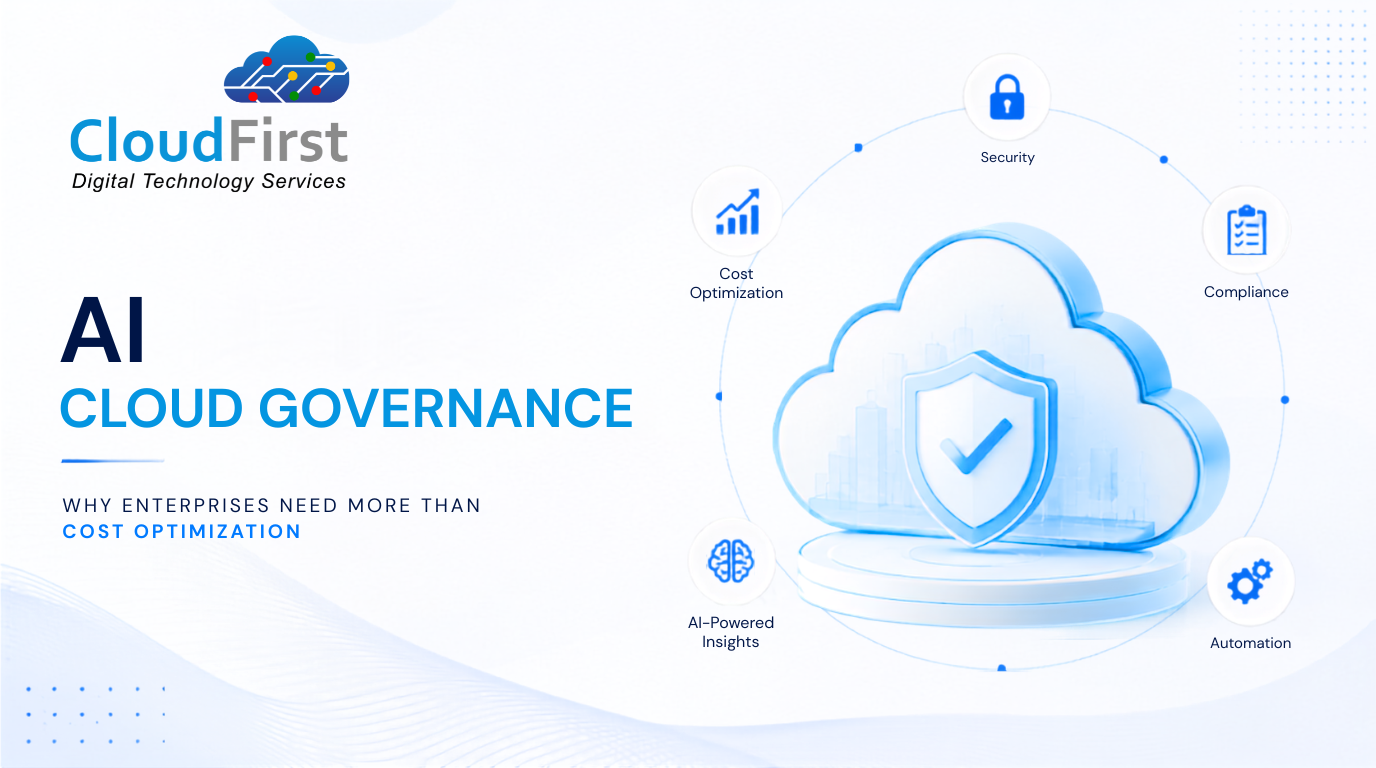
Cloud adoption has reached a stage where simply migrating workloads is no longer enough. Enterprises today operate across multiple cloud providers, deploy AI-powered applications, manage distributed teams, and process enormous volumes of data every second. While the cloud offers unmatched flexibility and scalability, it also introduces growing challenges around governance, security, compliance, and uncontrolled spending.
For years, organizations focused primarily on cloud cost optimization. Although reducing unnecessary cloud expenses remains important, today's business leaders are realizing that cost savings alone cannot guarantee operational efficiency or long-term resilience.
The next evolution is AI-native cloud governance—a smarter approach that combines automation, security, compliance, FinOps, and operational intelligence into a unified strategy.
Organizations that embrace intelligent governance are not only reducing cloud waste but also building secure, scalable, and sustainable cloud environments for the future. This aligns with the broader industry shift toward AI-powered governance, automation, and unified cloud operations.
What Is AI-Native Cloud Governance?
AI-native cloud governance refers to using artificial intelligence, automation, and real-time analytics to manage cloud environments proactively rather than reactively.
Instead of relying on manual monitoring and periodic audits, AI continuously evaluates cloud infrastructure by:
- Detecting unusual cloud activity
- Monitoring security risks
- Enforcing compliance policies
- Identifying unused or oversized resources
- Recommending infrastructure improvements
- Predicting future cloud spending
- Automating governance tasks
This creates a cloud environment that is not only optimized for cost but also secure, compliant, and operationally efficient.
Why Traditional Cloud Management Is No Longer Enough
Modern enterprises often operate across AWS, Microsoft Azure, and Google Cloud simultaneously. Development teams launch new resources daily, AI workloads consume large amounts of compute power, and data continuously moves between services.
Without proper governance, organizations frequently encounter:
- Cloud cost sprawl
- Idle or underutilized resources
- Configuration drift
- Security vulnerabilities
- Compliance violations
- Manual operational overhead
- Limited visibility across cloud environments
Managing these challenges manually becomes increasingly difficult as cloud environments grow.
This is why intelligent governance is becoming a strategic business requirement rather than simply an IT initiative.
The Five Pillars of AI-Native Cloud Governance
1. Intelligent Cost Optimization
Many organizations unknowingly pay for cloud resources that provide little or no business value.
AI-driven analytics can automatically identify:
- Idle virtual machines
- Unused storage volumes
- Overprovisioned databases
- Inefficient compute utilization
- Duplicate infrastructure
Instead of producing static monthly reports, AI continuously recommends optimization opportunities that reduce unnecessary spending while maintaining application performance.
The result is improved cloud cost optimization without disrupting critical workloads.
2. Continuous Cloud Security
Cyber threats continue to evolve, making continuous security monitoring essential.
AI enhances cloud security by:
- Detecting abnormal user behavior
- Identifying unauthorized access attempts
- Monitoring privileged accounts
- Discovering exposed cloud resources
- Prioritizing critical vulnerabilities
Rather than waiting for scheduled security reviews, organizations gain real-time visibility into potential risks before they become incidents.
3. Automated Compliance
Regulatory compliance has become increasingly complex across industries including finance, healthcare, manufacturing, and government.
AI-powered governance helps organizations continuously monitor compliance with industry standards and internal policies by automatically:
- Detecting policy violations
- Monitoring resource configurations
- Validating encryption settings
- Tracking access controls
- Generating audit-ready reports
Automation significantly reduces manual effort while improving compliance readiness.
4. Operational Intelligence
Cloud environments generate enormous amounts of operational data.
AI transforms this data into actionable insights by identifying:
- Performance bottlenecks
- Capacity constraints
- Infrastructure anomalies
- Application dependencies
- Resource utilization trends
Instead of reacting to outages, IT teams can proactively prevent issues before they affect users.
5. Sustainability Through Cloud Efficiency
Sustainability is becoming an important objective for enterprise technology leaders.
Every unnecessary virtual machine, oversized database, or idle storage volume consumes additional energy inside cloud data centers.
By optimizing cloud infrastructure, organizations can:
- Lower infrastructure consumption
- Reduce energy usage
- Improve cloud efficiency
- Support ESG initiatives
- Decrease their overall environmental footprint
Cloud optimization increasingly delivers both financial and sustainability benefits.
AI Is Transforming FinOps
Traditional FinOps focused primarily on tracking cloud bills.
Modern AI-powered FinOps is far more intelligent.
Organizations can now:
- Forecast future cloud costs
- Predict workload growth
- Identify budget risks early
- Recommend infrastructure changes
- Allocate costs automatically across business units
This enables finance and engineering teams to make faster, data-driven decisions instead of reacting after costs have already escalated.
Why Unified Cloud Governance Matters
Many organizations rely on separate tools for:
- Cloud monitoring
- Security management
- Cost optimization
- Compliance reporting
- Resource inventory
- Automation
Managing multiple disconnected platforms creates operational complexity and fragmented visibility.
A unified governance platform centralizes these capabilities into a single operational view, enabling teams to:
- Improve decision-making
- Accelerate incident response
- Reduce operational overhead
- Standardize governance policies
- Simplify cloud operations
The industry is increasingly moving toward integrated cloud governance platforms that combine security, cost management, automation, and AI-driven insights.
Preparing for the Future of Cloud Operations
Cloud environments will only become more complex as organizations expand AI adoption, multi-cloud strategies, and data-driven operations.
The enterprises that succeed over the next decade will not simply spend less on the cloud—they will operate it more intelligently.
By embracing AI-native cloud governance, businesses can achieve:
- Better cloud visibility
- Stronger security posture
- Continuous compliance
- Optimized cloud costs
- Faster operational decisions
- Sustainable infrastructure growth
- Greater business resilience
Cloud governance is no longer just about managing infrastructure—it is about enabling innovation with confidence.
How CloudFirst Technology Helps Businesses Modernize Their Cloud
At CloudFirst Technology, we help organizations build secure, scalable, and intelligent cloud environments through AI-powered cloud transformation solutions designed for modern enterprises. Our expertise spans the entire cloud lifecycle—from strategy and migration to optimization, security, and ongoing operations.
Our services include:
- Cloud Modernization – Accelerate migration and modernize legacy workloads with AI-native cloud architectures.
- Security & Reliability – Strengthen cloud security, automate compliance, and improve operational resilience.
- Data Intelligence – Unlock business insights with intelligent data platforms, governance, and analytics.
- DevOps Automation – Streamline application delivery with CI/CD, Infrastructure as Code (IaC), and automation.
- Cost Optimization (FinOps) – Optimize cloud spending through intelligent resource management and financial governance.
- Managed Cloud Services – Ensure 24/7 monitoring, proactive maintenance, and continuous cloud performance.
- reinforce360 Platform – Our AI-powered cloud governance platform unifies cost management, automation, compliance, resource optimization, and sustainability into a single intelligent solution.
Whether you're beginning your cloud journey or optimizing an enterprise-scale environment, CloudFirst Technology helps you transform your cloud into a secure, efficient, and future-ready business platform.